
Key Takeaways
- W-2s and 1099-NECs must be sent to workers by February 2, 2026 (for the 2025 tax year).
- Those same forms must also be filed with the government by February 2, 2026, whether you file electronically or on paper.
- If you file 10 or more total information returns, electronic filing is required.
- Misclassifying an employee or contractor can lead to significant financial liabilities for your business
If you’ve owned your DMV business for long, you’re familiar with the rhythm: A new year begins. 1099s and W-2s have to be reported and sent out.
But we’ve gone all the way around the sun since you last completed this task. So, I wanted to give you a refresher on best practices for knocking it out before the deadline. And, update you on the last date for employers to send out W-2 and 1099 forms for 2026.
What’s the last date for employers to send out W-2 and 1099 forms?
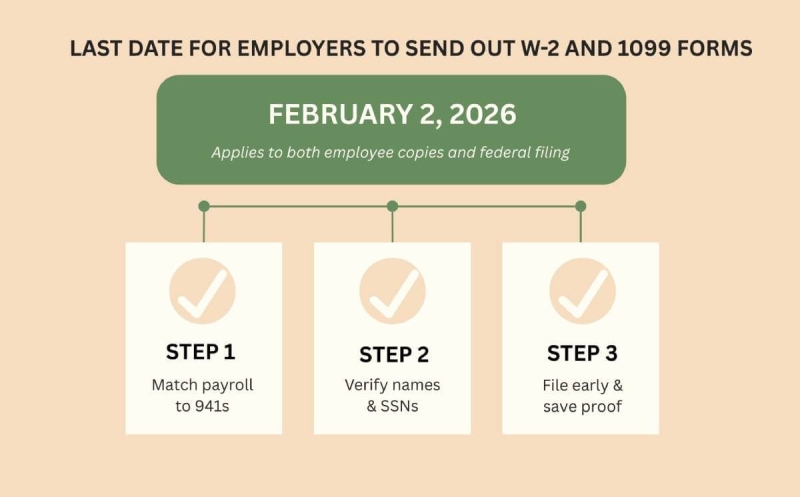
For the 2025 tax year, the key date to know is February 2, 2026. By that date, as an employer, you must do two things at the same time:
- Provide Form W-2 to each employee
- Provide Form 1099-NEC to each qualifying independent contractor
That same February 2 deadline also applies to filing those forms with the government. W-2s are filed with the Social Security Administration, and 1099-NECs are filed with the IRS. (And unfortunately, penalties apply even if employees received their copies on time.)
But although February 2 is legally the last date for employers to send out W-2 and 1099 forms, I recommend we aim to have everything finalized by January 25.
Why the early internal deadline? Once the February 2nd deadline passes, any correction requires a formal Form W-2c, which often triggers amended payroll tax returns (Form 941-X) and potentially extra fees from your payroll provider or your CPA.
So, by making the January 25 deadline, you avoid those amendment fees and reconciliation discrepancies that make your CPA’s job harder (and more expensive) later.
Also, while some states have later deadlines, many match the federal deadline. Finishing early ensures we don’t miss any state-specific nuances.
Do I have to file 1099s and W-2s electronically?
The IRS requires electronic filing if you submit 10 or more total information returns. The IRS adds everything together: W-2s, 1099-NECs, 1099-MISCs, 1095s, and other information returns.
Let’s say you have 6 employees and 5 contractors. You might think, “I’m under 10 for each type of form, so paper filing is fine.”
But the IRS counts the total forms (11, in this case), so then you’d be required to e-file.
Even if you’re below the 10-form threshold, e-filing is still the cleaner option. It provides instant confirmation from the SSA or IRS and creates a clear audit trail showing when and how your forms were submitted.
And yes – even if your payroll service prepares and files the forms, you are still responsible for ensuring W-2s and 1099s go out by February 2, and you receive and retain proof of submission.
Contractor vs. employee?
Before we finalize 1099s, we should review any cases where you’re not sure if a worker should receive a W-2 or a 1099. Because misclassifying a worker can lead to pretty significant financial liability for your business.
You can usually figure out which category they belong to by asking a few questions:
Does your Washington business direct how the work is done, or does the worker choose their own methods? If you are dictating their specific hours or providing detailed training, they may be an employee.
Who provides the tools, and how are expenses handled? Typically, contractors use their own equipment and bear the risk of profit or loss, while employees have their expenses reimbursed and use company resources.
Is the work ongoing and central to your business, or is it a project-based engagement? Long-term, indefinite roles are a primary indicator of a W-2 relationship.
And if you’re still unsure, don’t take a guess. I can help you pull the needed data for your CPA to make a final determination before you issue any forms. And of course, never pay a contractor if you don’t have their W-9 on file.
How do I get W-2s and 1099s filed accurately and on time?
To make sure the data I’m managing for you is accurate, we need to collaborate on a few steps:
Step 1: Reconciliation. We need to match your total payroll runs against your quarterly Form 941 filings. If something doesn’t line up, it’s usually a missed overtime entry, a bonus that posted late, or a year-end adjustment that never made it into payroll.
Step 2: Verification. We need to double-check employee names and Social Security Numbers. I recommend asking your team to review their final 2025 pay stubs now to catch any spelling or address issues. Also, make sure all Form W-9s are collected and updated.
Step 3: Documentation. Once the forms are filed, I will ensure we download and save the SSA confirmation receipts. We need to keep these on file for at least four years.
What happens if I miss the deadline for 1099s and W-2s?
I advocate for an early January 25 internal deadline because the IRS takes these dates seriously. When forms are late, it prevents your workers from filing their own taxes, which triggers automated penalties for your business.
The IRS uses a “tiered” penalty system, meaning the faster we fix a mistake, the less it costs the business. For small businesses (averaging $5 million or less in gross receipts over the last three years), the per-form penalties for the 2025 tax year are:
- Up to 30 days late: $60, with a max cap of $239,000.
- 31 days late through August 1: $130, with a max cap of $683,000.
- After August 1 (or not at all): $340, with a max cap of $1,366,000.
- Due to intentional disregard: $680, or 10% of the aggregate amount required to be reported (whichever is greater). No cap.
These penalties apply separately for failing to file with the government and failing to provide a copy to the worker. This means a single missing W-2 could technically result in a double penalty.
If you do miss the deadline, your first move should be to work with your CPA to file ASAP. The sooner you correct the error, the lower the fine.
In certain cases, you can request a penalty waiver if the delay was due to “reasonable cause,” such as a federally declared disaster or an unavoidable absence. We can help provide a clean audit trail of our records so your CPA can advocate for a penalty waiver on your behalf. However, these aren’t often granted, so hitting our January 25 target remains our best defense.
Final thoughts
If getting your 1099s and W-2s squared away by January 25 sounds like a heavy load, let’s talk. Because while it might mean a little extra sweat early in the month, having that buffer week to catch mistakes could save you a lot of stress later.
So, let’s get your data in order together:
calendly.com/cfosg_growth/sales-consultation
FAQs
“What is the official 2026 deadline for W-2 and 1099-NEC forms?”
For the 2025 tax year, the deadline is February 2, 2026. While the date is normally January 31, it moves to the next business day in 2026 because the 31st falls on a Saturday. This deadline applies to both providing the forms to your workers and filing them with the government.
However, a much safer deadline to aim for is January 25. Filing by this date gives you time to correct any mistakes that might’ve slipped through, so you can avoid penalties.
“Can I get an extension for filing W-2s or 1099-NECs?”
Extension requests for these forms are not automatic and are rarely granted. You must file Form 8809 by February 2 and provide a detailed explanation of the “special circumstances” or hardships that prevent on-time filing. Even if granted, an extension usually only provides an extra 30 days.
“Am I required to file my W-2s and 1099s electronically this year?”
E-filing is required if you have 10 or more total forms. As your bookkeeper, I don’t just look at W-2s; I aggregate your W-2s, 1099-NECs, 1099-MISCs, and 1095s to see if we hit that threshold. E-filing is our standard practice because it gives us an instant digital audit trail.
“What happens if I miss the February 2 filing deadline?”
The IRS is strict, with penalties starting at $60/form and potentially reaching $680/form for ‘intentional disregard’. My job is to ensure your payroll and contractor records are ‘clean’ and reconciled before February 2. If we do miss a deadline, my first priority is getting the data filed immediately to stop the ‘penalty clock’ from moving to the next tier.
“How do I file W-2s and 1099s if I missed the deadline?”
You should still file as soon as possible to stop the penalty clock from ticking. W-2s are filed with the Social Security Administration (SSA) via their Business Services Online (BSO) portal. For 1099-NECs, you can use the IRS Information Returns Intake System (IRIS), which is a free portal for small businesses.
“Do I need to file a 1099-NEC for every contractor I paid?”
You only need to file Form 1099-NEC if you paid an independent contractor $600 or more during the 2025 tax year. Note that this threshold is scheduled to increase to $2,000 starting in the 2026 tax year (for forms filed in 2027). My role is to help you track these payments year-round so we know exactly who crosses that line by December 31.
“My payroll service handles my W-2s; am I still liable for errors?”
Yes, even if you use a third-party payroll provider, the business owner is ultimately responsible for the accuracy and timely submission of these forms. Always request a confirmation receipt from your provider to keep for your records.