

Key Takeaways
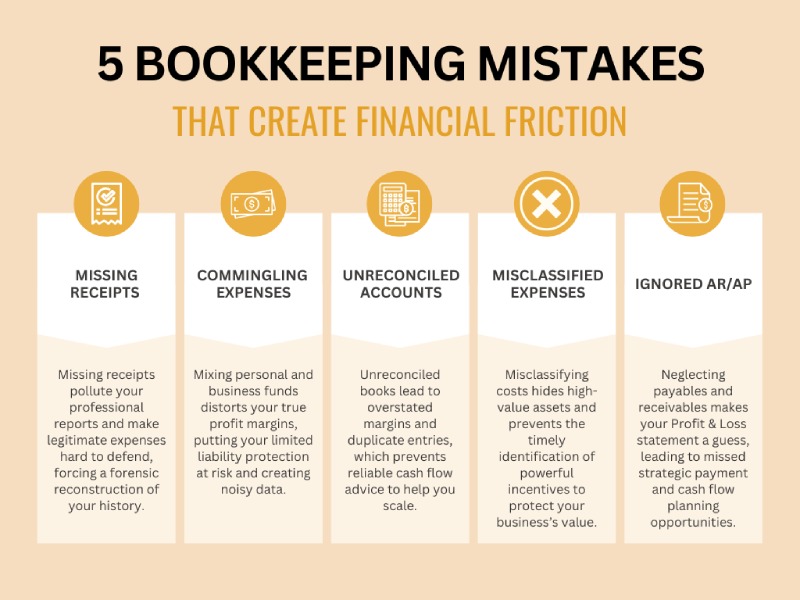
- Missing documentation shifts the burden of proof to you. Without a receipt or digital log, it is difficult to defend your records during a year-end review, often resulting in disallowed deductions and higher taxable income.
- Commingling personal and business funds distorts your true profit margins. Mixing expenses makes it nearly impossible to provide accurate financial advice and can “pierce the corporate veil,” putting your personal assets at risk..
- Skipping bank reconciliation creates “ghost data.” Failing to match software entries to bank statements leads to duplicate deposits and missing expenses, causing you to pay taxes on income you never actually received.
- Misclassified expenses hide high-value tax incentives. Labeling a capital asset as a simple office supply distorts your business’s true value and prevents your tax preparer from easily identifying powerful breaks like Section 179 depreciation.
- Ignoring AR and AP distorts your true financial health. Without tracking what you owe and what is owed to you, your Profit & Loss statement becomes a guess, leading to inaccurate year-end snapshots and missed strategic payment opportunities.
Did closing out your 2025 books and filing your 2025 taxes this year feel like trekking through mud?
If you’re currently nodding your head, then let me ask another question:
How’s your bookkeeping?
When your books are messy, tax preparation and year-end tasks become a forensic exercise of chasing and reconstructing records. This pulls your energy away from growth and creates unnecessary stress.
Here are five common bookkeeping mistakes that likely made things difficult this year, and how to fix them to ensure your data is lead-ready for the future.
Mistake #1: Missing receipts and documentation
One of the most common bookkeeping mistakes is missing receipts and documentation, which forces us into a forensic mode rather than a strategic one and makes handing them off to your accountant for tax filing difficult:
1. The burden of proof is on you
Under IRS guidelines, the taxpayer (i.e., you) carries the “burden of proof.” If you’re audited and can’t produce a contemporaneous record (a receipt or digital log) of an expense, the IRS has the right to completely disallow that deduction. This results in higher taxable income, back taxes, and potential penalties.
2. You’re missing out on savings
If you can’t find the documentation, it’s hard to claim the expense. Small miscellaneous costs, like the $15 software subscription, the $40 client coffee, or the $100 office supply run, add up quickly. Over a year, missing documentation for these small items can cost you quite a bit in legal tax savings.
3. Increased operational costs
When you hand me a bank statement instead of categorized receipts, I have to spend more time reconstructing your year. You end up paying for a “detective” to hunt for data rather than a strategist to help you grow.
What documentation is required for a clean audit trail?
To ensure your books are ready for a seamless year-end handoff, every record should include:
- Who you paid
- The amount
- The date of the transaction
- A quick note on why this was necessary for your DMV business
Mistake #2: Mixing personal and business expenses
Letting your personal and business expenses get mixed is one of the most common bookkeeping mistakes I see. If you operate as an LLC or a Corporation, one of your primary goals is limited liability. This means your personal assets (like your home) are protected from business debts.
However, if you treat your business account like a personal piggy bank, you risk a court “piercing the corporate veil.” From a strategic perspective, this commingling also distorts your true profit margins, making it impossible for me to provide accurate advice on your business health.
There is also a significant forensic risk to consider. When personal expenses show up on your business ledger, it triggers skepticism during a review. If an auditor finds one personal expense disguised as a business deduction, they are legally entitled to scrutinize every single transaction you made that year—including your personal bank accounts.
How to separate your personal and business expenses
Now is the perfect time to reset. Here are the best practices I recommend to clients for keeping expenses separate and ensuring your data is lead-ready:
- Audit your Q1 2026 transactions. If you see personal swipes on the business card, categorize them as “Owner’s Draw” immediately so they don’t pollute your professional reports.
- Designate one credit card and one checking account for business only. If you accidentally use the wrong card, reimburse the correct account immediately and keep a note of the transfer.
- Instead of dipping into the business account for personal needs, set up a scheduled transfer (an Owner’s Draw or Salary) to your personal account. This keeps your business ledger clean and makes your personal cash flow easier to manage.
- Use a digital receipt tracking tool that syncs with your business account. If a transaction doesn’t have a corresponding business receipt, it shouldn’t be in your business books.
Mistake #3: Not reconciling bank accounts regularly
Reconciling your accounts monthly is the only way to ensure the numbers in your software match the reality of your bank statements. Without this regular check-in, your Profit & Loss statement becomes a guess rather than a reliable guide for your business decisions.
Skipping this is one of the most common bookkeeping mistakes that makes your year-end higher:
- You risk relying on “ghost data.” Without reconciliation, duplicate entries or missing expenses go unnoticed. This often leads to overstating your income—causing you to pay taxes on money you never actually received—or understating expenses, which artificially inflates your profit margins.
- It creates a massive forensic cleanup in January. If you wait until the end of the year to reconcile, you’re forced to investigate transactions that are 12 months old. It is much more expensive to pay an advisor for forensic reconstruction than it is to maintain system integrity month-to-month.
- It hides banking errors and fraud. Regular reconciliation allows us to spot bank errors, duplicate subscriptions, or unauthorized charges immediately. The longer these issues sit in your books, the harder they are to resolve with your financial institution.
How to stay on top of reconciliation
Now that Quarter 1 is behind us, use this month to ensure your data is clean and lead-ready:
Step 1: Set the same day every month as your reconciliation date.
Step 2: Open your software and ensure your Statement Ending Balance matches your Cleared Balance exactly.
Step 3: Review outstanding checks: If you see a check you wrote six months ago that hasn’t cleared, investigate it. It might be a duplicate or a lost payment that is distorting your true cash flow.
Step 4: Check the uncleared transactions. If you have dozens of old transactions that haven’t cleared the bank, they are likely “ghost data” errors that need to be deleted to prevent your profit from being understated (or overstated).
Mistake #4: Misclassifying expenses
Another of the common bookkeeping mistakes I see is misclassifying expenses. Misclassification happens when you assign a business expense to the wrong category in your Chart of Accounts. This often looks like labeling a fixed asset (like a $3,000 MacBook) as a simple office supply.
How does misclassifying your expenses impact your decision-making?
- Misclassifying triggers automated audit flags by distorting your industry benchmarks. The IRS compares your business to others in your industry, so if your supply or travel categories are 400% higher than your peers because equipment was tucked there, you are creating a red flag rather than a strategic deduction.
- The real value of what your business owns is hidden, and your profit appears lower than it actually is. Items that have a useful life of more than one year are Capital Assets; if you expense a $5,000 purchase today, you miss out on accurate asset tracking and risk penalties for underpaying estimated taxes.
- It’s difficult to easily identify high-value incentives like Section 179 or Bonus Depreciation. These are the primary tools used to lower your taxable income, but I cannot apply them if the assets are buried in a “Miscellaneous Expense” category
What are the most common expense misclassification mistakes small business owners make?
1. Labeling capital assets as operating expenses
You might buy a $3,000 high-end laptop or a $5,000 piece of machinery and label it as an office supply or repair. Because these items have a useful life of more than one year, they are typically Capital Assets.
Expensing the full amount today makes your profit look lower than it actually is and prevents me from accurately tracking the value of your business.
2. Recording full loan payments instead of interest only
When you pay a business loan or commercial mortgage, the mistake is categorizing the entire payment (e.g., $1,200) as a “Loan Expense”.
In reality, only the interest portion is a deductible expense. The rest is reducing a liability on your balance sheet.
If we don’t split these, we are overstating your expenses and distorting your true cash flow.
3. Lumping meals and entertainment together
As of current tax law, entertainment is 0% deductible. Meals are typically 50% deductible. (Although there are some exceptions. For instance, as of 2026, office snacks and coffee no longer qualify for this or any deduction; and some office holiday parties can qualify for a 100% exception, etc.)
If you lump them together, I have to assume the worst-case scenario (0% deduction) to keep you safe from an audit. Or, I have to spend hours digging through receipts to see which was a sandwich and which was a stadium ticket.
4. Recording inventory purchases as an immediate expense
Categorizing a $10,000 bulk order of materials as an expense the moment you buy it is a major red flag. You generally only deduct the cost of items once they are sold. Until then, that $10,000 is an asset called inventory. Over-buying at year-end to hide profit is a common audit trigger that we avoid through proper tracking.
5. Confusing contractors with payroll employees
You may be tempted to label a virtual assistant or a freelance graphic designer as “wages” or “salary.” But wages are only for W-2 employees, where you withhold taxes. Keeping freelancers in a dedicated “Subcontractor” or “Professional Fees” category ensures your records match the 1099-NECs we provide at year-end.
How to classify expenses correctly
Here are a few tips to help you categorize your expenses more accurately:
- If you have a category called “Misc” or “Other,” delete it. Every dollar spent should have a specific home.
- Generally, any single item over $2,500 should be flagged for me to review as a potential “Asset” rather than an “Expense.”
- Create a specific folder or category in your software for things you aren’t sure about so we can review them together monthly.
Mistake #5: Ignoring Accounts Receivable (AR) and Accounts Payable (AP)
Ignoring these ledgers creates a structural mess for your decision-making. Without tracking what you owe (AP) and what is owed to you (AR), your Profit & Loss statement is essentially a guess.
- If you don’t clean up your AR, you risk paying taxes on income you billed but will never actually collect. We use bad debt write-offs to ensure you aren’t taxed on money that isn’t coming.
- If your invoices aren’t matched correctly to bank deposits, your revenue can be double-counted. This makes it look like you made twice as much money as you actually did, leading to an overpayment of taxes.
- If I don’t see your outstanding bills in the system, I can’t help you strategically time payments to manage your year-end position. Business bills left in an email inbox don’t exist to your advisor and can’t be used to lower your taxable income.
Common AR and AP mistakes to fix
Look for these specific errors in your current books:
1. Letting invoices sit in your AR from months (or years) ago that you know the client is never going to pay.
The fix: Perform a bad debt write-off. Instead of just deleting the invoice (which messes up your audit trail), you need to record a bad debt expense to offset the income. This ensures your financial reports don’t show “ghost income,” and you aren’t taxed on money that isn’t coming in.
2. Double-counting revenue. As I explained earlier, this happens when you create an invoice for $1,000, then receive the $1,000 in your bank feed and add it as new income rather than matching it to the existing invoice.
The fix: Review your open invoices report. If you see an invoice that you know was paid, but it’s still showing as “Open,” you’ve likely double-counted that income. Merging or matching these transactions is the only way to ensure your revenue numbers are accurate, so you avoid paying double the taxes.
3. The in-box expense filing system. If your business bills are sitting in your email inbox instead of being entered into your accounting software as Accounts Payable, they don’t exist to your advisor.
The fix: Enter bills the moment they arrive, even if you don’t plan to pay them for 30 days. This allows us to see your true liabilities in real-time and ensures no strategic deduction is left behind when we hand off to your tax preparer.
4. Unapplied vendor credits. Maybe a vendor overcharged you and gave you a $200 credit. If that credit is just sitting there unapplied, your AP balance is higher than it should be.
The fix: Regularly review your AP Aging Report for negative balances. Applying those credits to open bills keeps your liability numbers accurate and ensures your cash flow reports reflect reality.
Final thoughts
If this year’s tax filing left you feeling drained, it’s often because these common bookkeeping mistakes have been creating friction in your system all year long.
My goal is to prioritize these five areas of cleanup with you now, while the data is fresh. By setting up these guardrails in the second quarter, we ensure your books stay audit-ready and that your year-end handoff to your tax preparer is much smoother..
calendly.com/cfosg_growth/sales-consultation
FAQs
“How long should I keep receipts for my business?”
You should generally keep business receipts and supporting documentation for three years from the date you filed your original return. For specific items like bad debt deductions or worthless securities, keep those records for seven years. I recommend digital copies; they ensure your records are organized and instantly accessible for our mid-year reviews or when it’s time to hand your data off for tax filing.
“Can I deduct business expenses if I lost the actual receipt?”
It is possible under the Cohan Rule if you can prove the expense was legitimate (e.g., via bank statements or calendar entries). However, this does not apply to travel, meals, or gifts, which require strict documentation. Relying on estimates turns your year-end into a forensic exercise. Using a digital capture tool today ensures your deductions are defensible the moment they occur.
“Does the IRS require receipts for business expenses under $75?”
Generally, the IRS does not require a receipt for business expenses under $75 (excluding lodging). However, you still need to document the date, place, and business purpose in your records. I recommend keeping every receipt regardless of the amount to provide a clean audit trail and ensure you don’t miss out on cumulative savings.
“What are the legal risks of mixing personal and business bank accounts?”
Commingling funds can lead to ‘piercing the corporate veil,’ making you personally liable for business debts. From an advisory perspective, it makes your Washington business look like a hobby rather than a separate entity. This distorts your profit margins and leads to the disallowance of deductions during a year-end review.
“Why does my bank balance in my accounting software not match my actual bank statement?”
This discrepancy usually indicates a lack of monthly reconciliation. When bank feeds or uncleared checks aren’t resolved, your Profit & Loss statement becomes inaccurate. This prevents me from giving you reliable cash flow advice and creates significant cleanup costs at year-end.
“Is a new office computer a business expense or a capital asset?”
Typically, a computer is considered a capital asset because it has a useful life of more than one year. While you might want to deduct the full cost immediately, it usually must be depreciated over five years. However, using Section 179 or Bonus Depreciation, we can often deduct the full price in the first year… but only if it’s correctly classified as an asset in your books first. Or, if the computer costs $2,500 or less, you can use the De Minimis Safe Harbor Election. You don’t have to call it an asset at all. You just list it as a “Supplies” or “Office Expense.”
“What is the difference between a business repair and a business improvement?”
A repair (like fixing a broken window) is a current expense that is 100% deductible in the year it happens. An improvement (like putting a new roof on your office) adds value or extends the life of the property and must be capitalized and depreciated over many years. Categorizing these correctly ensures your balance sheet reflects the true value of your business assets and avoids common audit triggers.